Building Information Modeling (BIM) has become the cornerstone of modern construction. It provides better collaboration, less rework, high-quality project results, and better cost control. Although it has many advantages, BIM methods often fail to reach their full potential.
Several construction companies invest in software or tools, assuming that they are "doing BIM." But BIM is more than just a tool. It is a strategic change in the construction process that requires skills, project management transformation, and organized implementation techniques.
Adoption and implementation of BIM requires professional expertise, underscoring the importance of professional BIM consulting services. So, let us now check the common reasons why BIM adoption fails and how the right experts can offer you long-term success.

A common misconception about BIM is that it is better than CAD. It is wrong to consider BIM as a plug into your workflow that enhances coordination. But BIM is nothing like any other upgraded software platform. It is a process-based approach that has its own share of adoption challenges, like:
● Lack of a clear BIM strategy
● Inconsistent modeling standards
● Poor coordination across disciplines
● Inadequate training and skill development
● Resistance to change and cultural pushback
● Limited integration with existing systems
● Weak governance and quality control
These challenges stem from the lack of workflow organization, highlighting the importance of a BIM Execution Plan (BEP) to introduce transparency and uniformity to project teams. That is, the implementation of BIM can only fail when companies assume it like any other technical upgrade rather than as a well-organized change of operations.

Now that we know the reason behind BIM adoption challenges, here are a few main pitfalls and strategies to overcome with the help of professional BIM services:
The adoption of BIM by construction enterprises is usually not guided by a clearly set objective. This brings about confusion and irregular expectations in the delivery of projects, leading to poor BIM engagement.
BIM experts have the expertise to establish scalable BIM targets, business-driven KPIs, and road map milestones that align digital changes to business priorities. These professionals focus on:
● Defining strategic intent
● Identifying scalable KPIs
● Collaboration among teams
● Establishing realistic milestones
Well-established goals and management provided through professional BIM services indicate that construction firms are keeping themselves on track, accountable, and focused on long-term BIM performance.
Underdefined roles may cause confusion among teams, extensive reworking, ineffective coordination, and inappropriate use of BIM tools. This highlights the importance of choosing a BIM consulting company.
They help clarify project roles, define workflows, and set clear responsibilities. BIM consulting services can help in setting clear role hierarchies, mapping competencies, and responsibility matrices for optimizing digital workflows by:
● Assigning defined ownership
● Creating a structured hierarchy
● Mapping required skills
● Streamlining communication paths
Clarity in project roles offered by experts can prevent workflow confusion, improve coordination, and ensure BIM responsibilities are efficiently executed.
Not having unified BIM standards may lead to unreliable data, incompatible design models, and differences in deliverable quality across construction projects.
BIM consultants help create custom standards, LOD protocols, and BEPs that enforce quality and consistency. They help in:
● Create custom templates
● Standardize model rules
● Define LOD requirements
● Establish naming systems
Professional BIM services enforce strong BIM standards to maintain uniformity, enhance coordination, and offer precision throughout the construction project lifecycle.
Construction teams often adopt BIM tools without adequate training and support. It leads to delayed adoption, user frustration, and inefficient model development.
BIM consultants offer role-specific, structured training programs and consistent skill development that meet the project needs. Professionals offer:
● Hands-on training
● Role-based modules
● Continuous learning
● Track skill progression
Specialized training on the adoption and implementation of BIM can assist teams in developing competency and confidence, which can positively influence the productivity of construction.

BIM will not work where teams do not work. It results in frequent conflicts, duplicated modelling, and disjointed deliverables. Using BIM Coordination services may facilitate cross-disciplinary workflow integration to achieve a smooth flow, reduce the number of clashes, and increase predictability of the project results.
BIM consultants established collaboration workflows and coordinated a clash detection strategy by:
● Enable shared access
● Define review cycles
● Facilitate team alignment
● Optimize data exchange
BIM experts strengthen interdisciplinary integration, reduce rework, and enhance project outcomes.
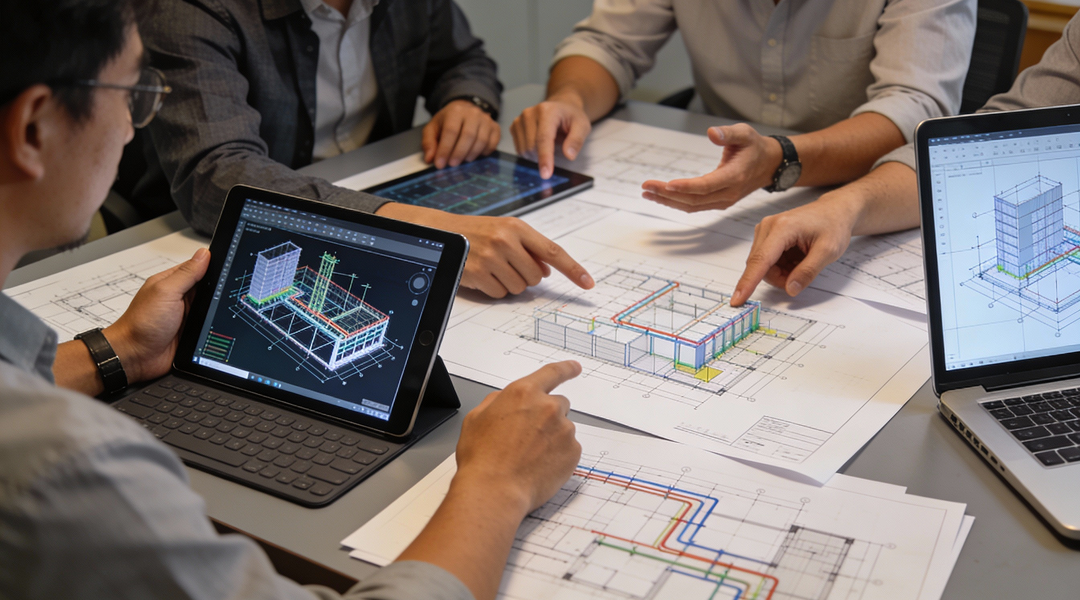
Organizations fail when BIM performance isn’t evaluated, preventing teams from identifying inefficiencies or improving digital workflows.
Construction firms often fail when BIM performance is not evaluated. It prevents teams from identifying inefficiencies or improving digital workflows. The consultants introduce BIM audits, dashboards, and maturity assessments for consistent enhancements. They help in:
● Measure workflow performance
● Identify process gaps
● Track maturity levels
● Review progress regularly
Consistent performance management ensures that BIM evolves strongly, aligning with organizational growth to meet project needs.
Disconnected tools, incompatible platforms, and poor template setup disrupt workflows and reduce BIM efficiency across teams. BIM consulting services streamlines the use of tools, customizes environments, and integrates every platform into a single digital ecosystem. They help in:
● Customizing BIM platforms
● Configuring template sets
● Integrating project tools
● Ensuring workflow alignment
Integration of technology is effortlessly done by BIM experts who help to improve project efficiency and reduce digital frictions.
When done properly, BIM is a game-changer. Nonetheless, when companies implement BIM without a consulting path, a significant number fail to adopt it effectively, become inefficient, and end up wasting funds.
Professional BIM services from Modelo Tech Studio bridge the gap between intention and execution. If you're considering BIM adoption or improving your current BIM workflow, contact us today, the most important step you can take toward digital transformation success.

Curious to dive deeper into BIM practices? Check out our related blog posts for more insights and strategies to elevate your projects!


.png)
We appreciate your interest in our services. To provide you with an accurate and comprehensive quote, we will need some general information about your project. This will help us understand your specific needs and tailor our proposal to meet your requirements effectively.
.png)